

Just two days ago I dropped an essay here in which I argued that much of mainline Protestantism has forgotten how to inhabit what I called a “charged world.” On the plus side, over the past hundred years or more, we learned to see structural evil with greater clarity. But with that new found clarity, over time, we lost our instinct that the world is a place which is spiritually contested—that St. Paul’s language of “principalities”, “powers”, angels, and demons is not just colorful religious metaphor but speaks to the existence of actual malevolent entities.
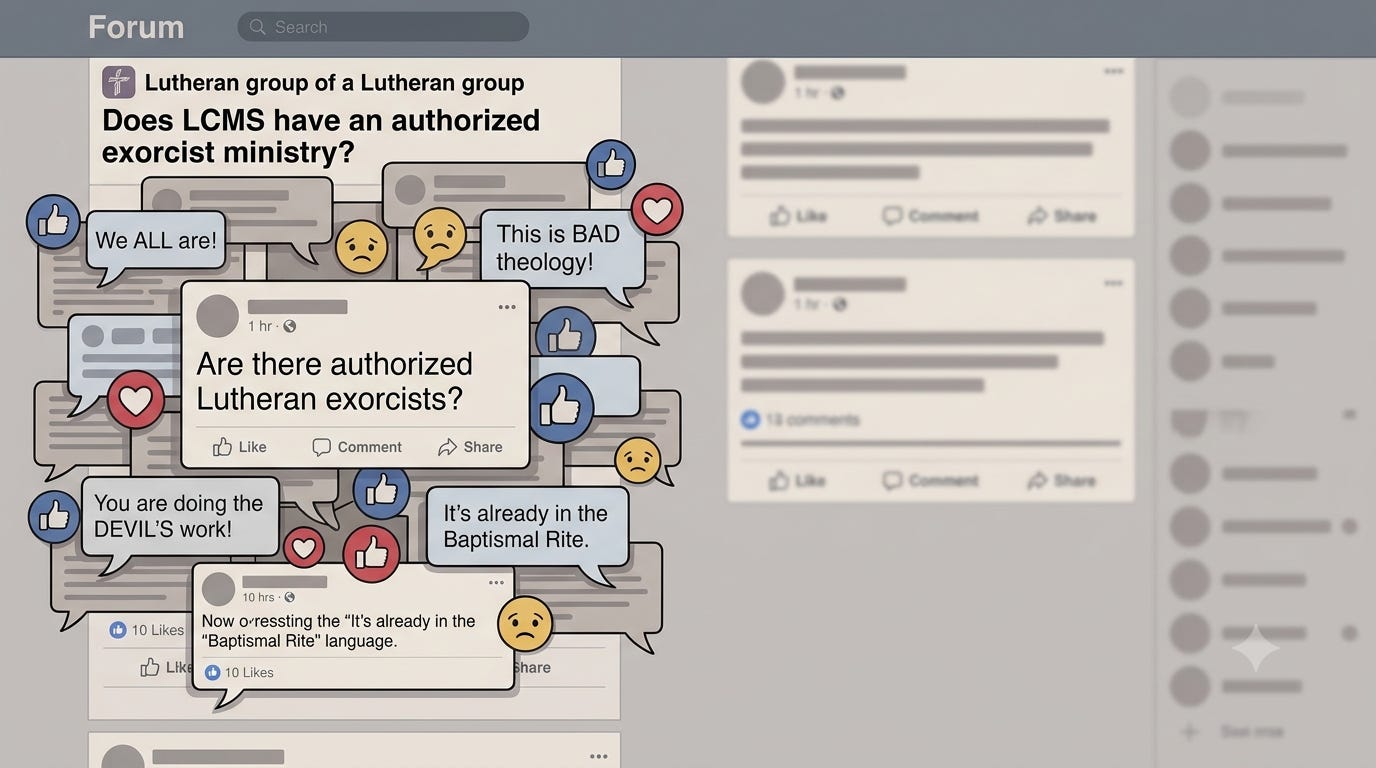
In a wonderful example of divine synchronicity, just a few hours later, Facebook handed me an illustration of this very issue. Someone in a large LCMS discussion group asked a simple, straightforward question: “Does the LCMS actually have a deliverance ministry? Are there authorized exorcists?”
It didn’t take long for the thread to have more than fifty replies. Some insisted every Christian should be casting demons out. Others dismissed all forms of deliverance ministry as “bad theology” rooted in fear of the demonic. One participant publicly accused another of “doing the devil’s work” and still another calmly reminded the thread that every Lutheran pastor already performs an exorcism in the baptismal liturgy at the section about the renunciations of evil.
They all thought they were answering the same question. They were, in fact, talking past one another. They had quietly substituted three distinct questions for the one the original poster asked. (1) Whether Lutherans believe in exorcism at all? (2) Whether pastors should have formal authority to perform it? (3) Whether individual lay Christians can undertake deliverance on their own?
Three Questions Masquerading as One
(For clarity, a brief note on terms: “exorcism” usually refers to the formal rite addressing possession; “deliverance” is the broader pastoral work of liberation from oppression or affliction. Likewise, diagnosis between psychiatric illness and spiritual affliction is real and needs to be explored as the first order of business in these matters.)
“Does Lutheranism contain a theology of the demonic?” Yes! The renunciations in the baptismal rite—“do you renounce the devil and all his empty promises”—is not just liturgical theater. It assumes a real adversary and a real deliverance in progress, accomplished in the water, by the Word, and not by technique (immersion, sprinkling, or pouring).
For Lutherans, baptism is the objective, “once-for-all” deliverance: the drowning of the old Adam and the definitive break of the devil’s claim on that person. It is complete and sufficient. But we also know from own experience that a baptized person may still experience particular oppressions, afflictions, or strongholds that settle in and require ongoing pastoral care. When these problems arise, it is not surfacing a deficiency in the person’s baptism (in 99% of cases there is no hint of invalidity). Rather, it is showing a difference between that definitive break made at the font and the acute need for some particular liberation that sometimes comes along afterward through the course of a life lived out.
The fourth member’s reply—pointing straight at the baptismal rite’s own exorcism language—was the most theologically sound post on the chain and it received ten “likes,” buried under speculation about other topics. But this person was actually answering the first question while the thread was asking the second and third. Thus, the confusion was apparent.
The Canonical Gap: Authority Without a Playbook
“Is there an office, a discipline, a formal process by which a specific person is authorized to discern and address a specific case of possession or oppression?”
Here the honest answer is: no. Not in the sense that Rome has. The Roman Catholic Church built a canonical exorcist role over centuries precisely because untrained intervention is dangerous. There are spiritual, psychological, and sometimes physical risks that need to be minimized. A diocese does not hand that faculty to just anyone who feels called. It requires the bishop’s appointment, ongoing supervision, specialized training, and—as another commenter further down the thread noted, correctly—increasingly a hospital or clinical setting. Getting the diagnosis wrong—in either direction—can kill someone if things go sideways.
Lutherans do not need to create a Roman style canonical office per se. What IS needed is accountable formation and oversight. Harold Ristau’s and Robert Bennett’s work exists because they recognized this gap and tried to build something like formation for it without inventing a parallel magisterium along the way. That’s a heavy lift that will likely never be done. But even having a few good books on these topics in the marketplace is a serious upgrade from some guy on Facebook describing the personal technique he cobbled together for clearing an infested house. Good luck with that!
Spiritual Warfare or Online Intimidation?
When the second member told a fellow member to “repent of your work for the devil” for disagreeing with him online, that was spiritual intimidation wearing spiritual warfare’s clothes. It is the same move the fourth member—the one who’d rightly pointed to the baptismal rite—received on the other end. They were impugned, in a public thread, for merely stating settled sacramental theology. If your theory of spiritual warfare produces more casualties among your own side than among anything demonic, that theory has a problem that no amount of “I promise, from personal experience” fixes.
Lessons From Both Ends of the Spectrum
I’ve had the unusual privilege of seeing two very different traditions wrestle with this problem up close. About 20 years ago, I trained for a couple of summers at Mundelein Seminary, alongside men preparing for the Roman Catholic Church’s exorcism ministry. At that time I was an LCMS pastor and I was invited to attend by Fr. Gary Thomas of the Archdiocese of San Diego, to whom I had reached out to for help in dealing with several cases in the parish I was then serving. The training I received was not focused on the drama and the spectacle of The Rite, but rather on the discipline: the insistence on ruling out psychiatric and medical concerns before anyone treated a case as demonic, the refusal to let one man act alone, the years of formation before anyone was handed the faculty to do anything other than observe and pray. Rome’s answer to “who’s authorized” is slow and bureaucratic on purpose. And it gets results.
I’ve also spent time in rooms on the other side of the ledger—with Fr. Mike Flynn, an Episcopal priest and Vineyard pastor, some other non-mainline clergy friends along the way whose healing ministry relied more on “in the moment” discernment of spirits and a team approach. Without Latin ritual or crucifix or holy water, relying heavily on the theology of ”authority in Christ,” they also conducted deliverance work that truly did set people free.
Neither of those perspectives operated from the claim of one person in the discussion thread who said deliverance theology “operates from a place of fear of Satan and demons.” I can understand his perspective. A spirituality that sees a demon behind every symptom is not healthier than one that denies the demonic exists at all. Both are failures of discernment. But this person stated it as a complete rejection of the entire ministry rather than a caution about its abuse. That type of overcorrection is what leaves a local congregation with no framework at all when a real case shows up. That is precisely how the original poster ended up needing two Roman Catholic friends and an Unbound prayer team in the Diocese of Joliet to resolve the problem. Unfortunately, his own current and retired pastors had nothing to offer him. And that is how I was trained in seminary as well. I remember being told that if we ever did encounter the demonic, that the best approach would be to find a Jesuit and let them handle it. (The professor may have had tongue planted firmly in cheek, but he could have been seriously concerned for our welfare a young inexperienced pastors. Coin flip I guess.)
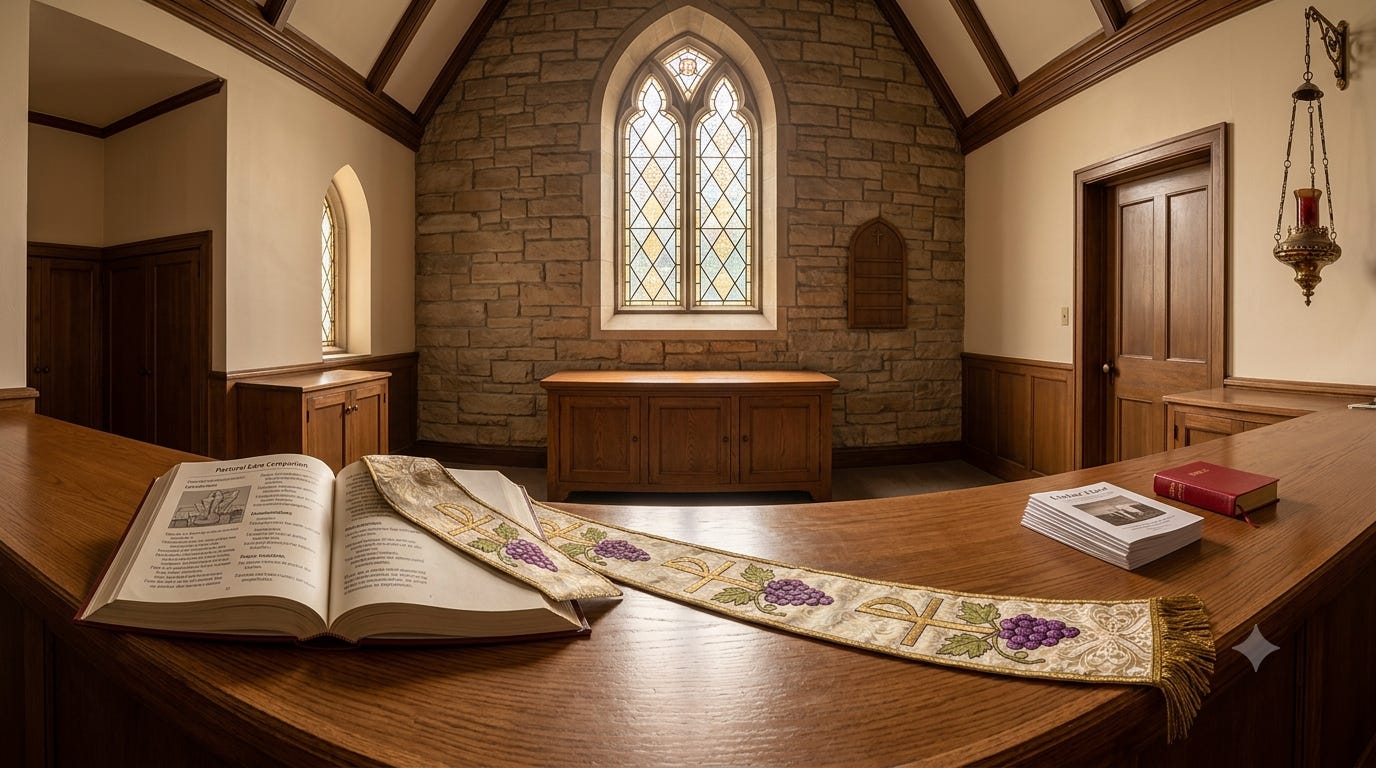
Here is what many don’t know: Lutheran theology does not lack the categories or the tools, but most of the folks entrusted with pastoral care are simply not formed to use them. The LCMS Pastoral Care Companion has a house-blessing rite with real teeth in its language. The ritual in the ELCA’s Pastoral Care is similar, but with a slightly different focus. In both traditions, the baptismal liturgy already does the deepest work.
But there is definite need for specialized training. Such formation is never a weekend seminar on “spiritual warfare techniques.” It begins with ordinary pastoral care. The first questions in any difficult case are almost always: Has this person seen a physician? Have they been heard by a confessor? Has ordinary Word and Sacrament ministry been given room to work?
Only after those are addressed does specialized discernment enter the picture. Formation then means learning the history of the rite and its variations across the various sacramental traditions, studying the clinical literature on dissociative disorders, trauma responses, and psychosis well enough to know when you are out of your depth, developing protocols for when and how to involve a circuit visitor or bishop. The goal is that no pastor ever discerns alone, and learns to pray for deliverance with a team rather than as a solo operator. That kind of formation takes years, not afternoons—and that is precisely why it is so rarely attempted.
The Uncomfortable Denominational Mirror
The more uncomfortable comparison here isn’t only between the thread’s factions. It’s between the LCMS having this fight at all and my own tradition mostly not having it. Fifty something replies—even with all of the confusion—still take for granted a real adversary, a real affliction, and a real question of pastoral competence. I’m so not confident that in an ELCA Facebook group, fifty people would show up to argue the best answer to the question rather than to debate and debunk the premise. Maybe I’m way wrong about that. Someone should test it out.
The congregation I serve as a long-term pulpit supply pastor is an exception to the mindset of most mainline gatherings. Light of Christ runs a food pantry and a street and recovery ministry, and the people who show up to our Thursday evening Bible study—former drunks, former addicts, men and women who’ve done time, people who’ve been homeless—they don’t need convincing about the existence of demons and sentient evil. They’ve lived the psychiatric kind of demons and named it. Plenty of them have also lived the other kind and named those, too. Often, in our discussions, in the particular way recovery communities do, these things surface as something that closed in on them, had a grip, and had to be broken, not just managed. These people could hold their own in the Facebook thread I’ve been describing.
How Discernment Becomes Ordinary
I didn’t weigh in on the discussion. You don’t fix this with a sharper Facebook comment. You fix it by training pastors to recognize the difference between a symptom needing a doctor, a soul needing to make confession and be absolved, and an affliction needing a team, a bishop’s knowledge/approval, and time. Until then, the Lutheran with a real problem will keep finding help somewhere else. The answer probably begins much smaller than another synodical committee: one circuit of pastors, one clinician, one psychologist, one difficult case, studied together month after month until discernment becomes ordinary instead of exceptional. If that becomes ordinary, the question of who gets to cast out demons will begin answering itself.
The Marginal Note is written by Rev. Dr. Steve Stutz, ordained Lutheran pastor, intentional interim minister, and certified spiritual director based in La Porte, Texas.
If you found this useful, forward it to someone who needs it.
Learn more about Steve’s work at stevestutz.com
Connect on LinkedIn: linkedin.com/in/stevestutzdmin